.png)
.png)

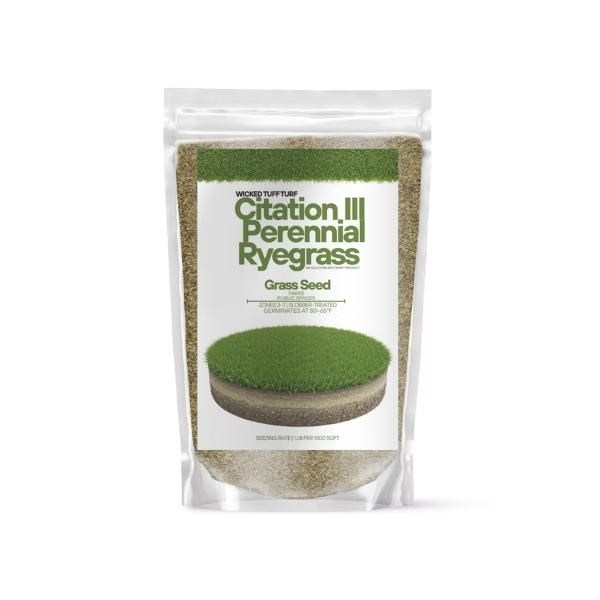
Old Cobblers Farm™ Citation III Perennial Ryegrass
$100.00
Citation III Perennial Ryegrass (Slobber-treated)
Seed Type & Composition
Seed Type — Cool-season perennial ryegrass, bred for rapid establishment and superior turf performance.
Coating Treatment — Slobber-treated for enhanced moisture retention, germination rates, and early seedling vigor.
Composition — High-purity, certified perennial ryegrass seeds ensuring uniform texture, dense growth, and weed resistance.
Application Use — Ideal for lawns, sports fields, golf courses, and overseeding purposes in cool climates.
Label Information
Purity (%) — Typically ≥ 90%, ensuring minimal contamination with other species.
Germination Rate (%) — Commonly ≥ 85%, guaranteeing strong seedling emergence.
Weed Seed (%) — Should be ≤ 0.5%, reducing unwanted weed pressure.
Other Crop Seed (%) — Typically ≤ 0.5%, maintaining varietal integrity.
Inert Matter (%) — Preferably ≤ 2%, maximizing viable seed content.
Lot Number — Batch identifier for quality tracking and assurance.
Test Date — Recent germination and purity testing date; freshness critical for performance.
Origin — Regional seed production area listed for climate adaptability.
Treatment Details — Slobber-treated; may include growth enhancers, pest resistance agents, or moisture-retaining coatings.
Geographic Suitability & USDA Zones
Primary Regions — Northern United States, Canada, temperate regions globally.
Optimal Use Zones — USDA Zones 3–7; thrives in cool, moist climates with moderate summers.
Transitional Zone Performance — Suitable in mixed cool/warm regions with adequate maintenance.
Sunlight Requirements
Full Sun to Partial Shade — Performs best with 4–6 hours of sunlight daily.
Dense Shade Adaptation — Limited; best suited for open areas or partially shaded lawns.
Soil Compatibility
Clay Soils — Acceptable with proper drainage management; may require organic amendments.
Loamy Soils — Ideal for nutrient retention and drainage balance.
pH Tolerance — Optimal range 5.5–7.5; adjust soil accordingly with lime or sulfur as needed.
Drainage Needs — Well-drained soils essential to avoid root diseases.
Watering & Drought Requirements
Establishment Phase — Maintain consistent surface moisture; water lightly daily until germination.
Post-Establishment — Apply 1–1.5 inches of water weekly, adjusting for rainfall and climate.
Drought Tolerance — Moderate; may enter dormancy under extended dry conditions but recovers with moisture.
Germination Time & Growth Pattern
Germination Period — 5–10 days under optimal soil temps (50°F–70°F).
Growth Habit — Bunch-forming with upright, dense leaf canopy; non-creeping.
Texture & Color — Fine-medium blades with vibrant, uniform green color.
Seasonal Growth — Vigorous in spring and fall; slows during peak summer heat.
Mowing & Maintenance
Mowing Height — 1.5–2.5 inches; raise height slightly during summer for stress reduction.
Mowing Frequency — Weekly during peak growth; more frequent as needed to maintain optimal height.
Fertilization — Apply balanced fertilizer early spring and fall; monitor nitrogen levels for density and color.
Watering Practice — Deep, infrequent watering encourages deep roots.
Aeration & Dethatching — Annual aeration recommended; dethatch as necessary to prevent buildup.
Weed & Pest Monitoring — Regular inspections with timely treatment when needed.
Foot Traffic Durability & Recovery
Durability — Suitable for moderate to high traffic; common in sports turf applications.
Recovery Rate — Rapid recovery due to fast germination; overseed worn areas promptly for best results.
Maintenance Needs — Regular mowing, fertilization, and overseeding maintain traffic tolerance.
Best Planting Times
Early Fall (Preferred) — Warm soil promotes germination; cool air reduces seedling stress.
Early Spring (Secondary Option) — Allows establishment before summer heat.
Avoid Summer Planting — Higher risk of desiccation and poor establishment.
Pest, Disease & Weed Resistance
Pest Resistance — Resistant to common turf pests with proper cultural care.
Disease Resistance — Strong against brown patch, red thread, and dollar spot; slobber treatment enhances resilience.
Weed Suppression — Dense turf coverage naturally inhibits weed establishment.
Appearance
Color — Rich, deep green consistent throughout the growing season.
Texture — Fine to medium blades with a soft, dense turf appearance.
Blade Characteristics — Upright, narrow leaves with smooth surfaces and slightly pointed tips.
Quantity